

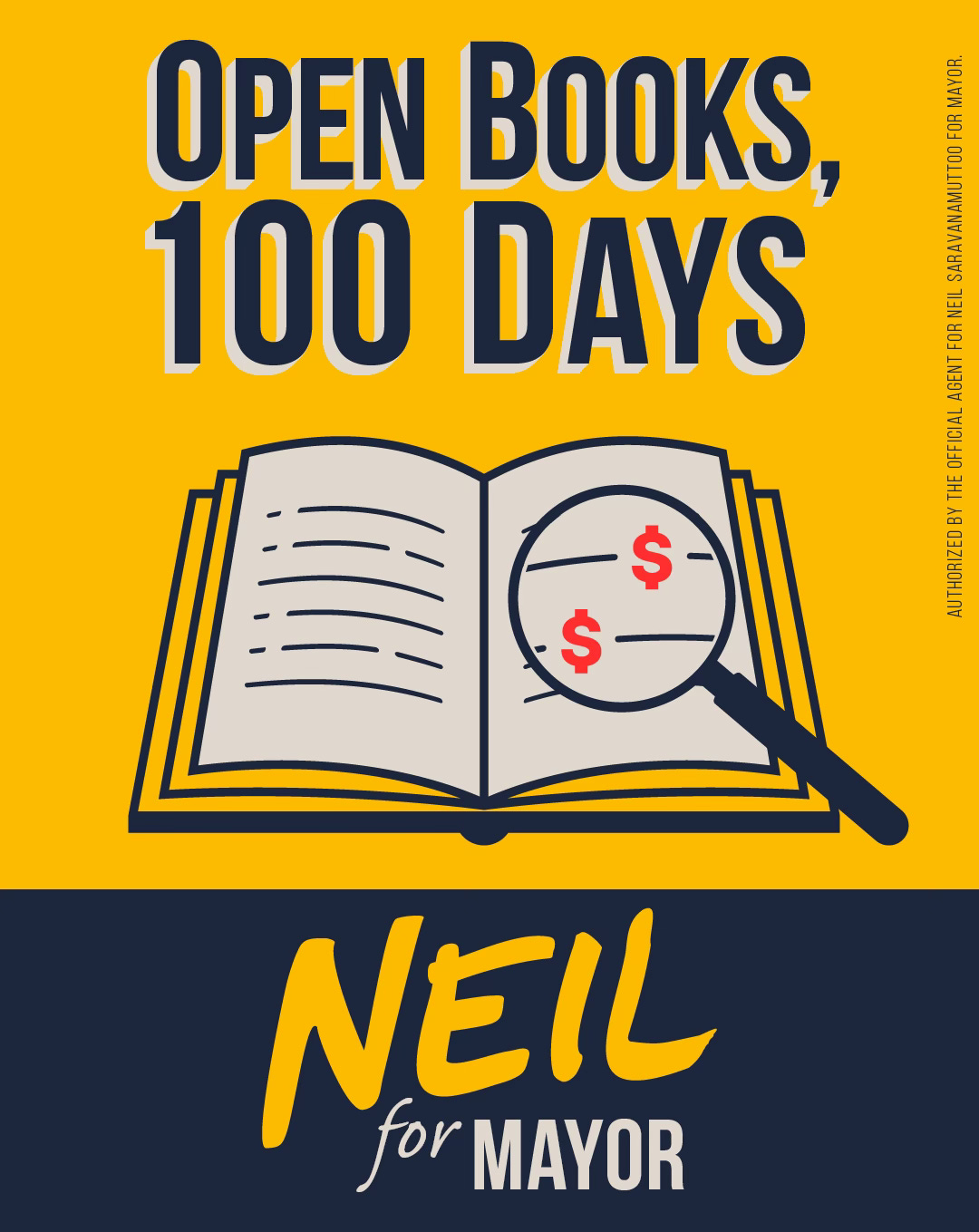
Open Books, 100 Days
This is how, as Mayor, I'll reduce waste and inefficiency at Ottawa City Hall.

How well are your taxes being spent?
The truth is, Ottawa taxpayers are in the dark.
City Hall spends billions of dollars every year. But residents still cannot clearly see where the money goes, whether we are getting value, or how Ottawa’s costs compare to other cities.
That changes with 100 Days, Open Books.
This is a core campaign promise. Within my first 100 days as Mayor, I will begin opening up City spending so residents can follow the money — through departmental budgets, contracts and invoices, and with clear comparisons with other cities.
Because this is our city. We pay the bills. We have a right to know how our money is being spent.
How much waste is hiding?
Even small inefficiencies can add up to a lot.
If just 1% of Ottawa’s budget is wasted, that over $50 million a year. That money could go to better transit, roads, housing or easing the pressure on taxes.
But what if the waste is 10%? Or 20%? Or even higher?
Right now, residents don’t know how much waste there is — because City Hall does not share information in a way that lets us find out.
That is why 100 Days, Open Books is needed.
Bogus savings are not good enough
Mark Sutcliffe claims City Hall found $250 million in savings over four years.
I challenge that assertion. The only real cut was the $10 million that was taken out of transit operations, with New Ways to Bus.
City departments were asked to identify savings but got to keep whatever that they found.
Not one City department actually had its budget reduced.
In a real spending review, all savings go back to the budget process for reallocation to higher priorities.
Ottawa needs a new approach to finding savings. Rather than ask departments to self-identify, we’re going to open the books.
Allow for public scrutiny and benchmarking. Let new technologies comb through the data to find anomalies. Under a Mayor willing to let taxpayers see what City Hall has been hiding.
If we overspend on the small stuff …
Sometimes, the details slip out.
Toronto and Montreal can install a speed bump for about $4,000. Ottawa’s cost is closer to $16,000.
A commemorative bench costs about $2,500 in Toronto, $3,000 in Markham, and $4,700 in Edmonton. In Ottawa, it costs between $6,400 and $6,900.
If Ottawa is overspending on speed bumps and benches, what are we overspending when it comes to major projects, like roads, sewers, transit, construction and IT?
100 Days, Open Books is how we find out.
What Open Books will do
Open Books will make City spending easier to see, easier to question, and easier to compare.
Within the first 100 days, we will start by:
providing more detailed breakdowns of departmental budgets
creating a public process for residents to ask spending questions
publishing much clearer and easier to understand financial data, in both human- and machine-readable formats
identifying priority areas for benchmarking against other cities, and
beginning the work of making contracts, invoices, and spending data accessible in ways anyone can understand.
Full Open Books will take time. But the initial phase will happen in my first 100 days.
That is the promise.
Expect pushback
City Hall will push back. Hard.
They will say the databases are too complex. They will raise privacy concerns. They will say it is too difficult, too technical, or too time-consuming.
To be clear: privacy must be protected. But privacy is not an excuse for secrecy.
Financial systems can be complicated. But how much we disclose is a choice.
A choice between openness and secrecy.
And that choice determines whether City Hall spends your money with the care it deserves — or not.
Sunshine is the best disinfectant
Opening up City spending will be embarrassing for the status quo.
Good.
As someone who has spent a career in public finance, I know Ottawa can do better.
And being raised in a Scottish family made me painfully careful with every dollar. That is the attitude I will bring to City Hall.
That is why 100 Days, Open Books will be one of my first acts as Mayor.
So there is nowhere for waste to hide.
And so Ottawa can put tax dollars where they belong: into the services, priorities, and results that matter to the people who pay the bills.
it's worth asking the councillors to justify why they elected to build sidewalks in Manor Park, where I have lived for over 35 years and have never heard of a pedestrian being struck by a vehicle. At least 4 surveys of area residents voted overwhelmingly against sidewalks and now the city is proceeded to waste money on these unwanted sidewalks, with little guarantee of year around maintenance and repair . The NRC has a study indicating that it is natural for sidewalks to crack in our climate, thus leading to a higher likelihood of falls. Concrete is also not environmentally friendly and acts as a heat sink. In some cities in Europe, they have elected to tear out their sidewalks.
Also, Findlay Creek is being buit without sidewalks. What is the standard then?
The city is quite transparent about what it spends on policing. What are your views on how it spends and what it spends?